The importance of business email security and how to get it right
Business Email Compromise (BEC) is a $2.8 billion problem. Your email isn’t just a communication tool, it’s the top entry point for financial fraud and data breaches. Discover how closing credential gaps and using zero-trust tools can build a definitive defense.
-
Nikita Alexander
- October 27, 2025
- 4 minutes

Business Email Compromise (BEC) is a $2.8 billion problem. Your email isn’t just a communication tool – it’s the top entry point for financial fraud and data breaches. Discover how closing credential gaps and using zero-trust tools can build a definitive defense.
Email remains one of the most essential communication tools in modern business and also one of the most targeted by cybercriminals. From phishing and spoofing to credential theft and ransomware, email threats are growing in scale and complexity.
According to the FBI’s Internet Crime Report, Business Email Compromise (BEC) remains one of the most financially damaging attack types, responsible for nearly $2.8 billion in losses in 2024. Despite its familiarity, email is still a top entry point for data breaches and financial fraud. For compliance-driven sectors like finance, simply adding a spam filter is no longer a strategy; it’s a gamble.
The Unmanaged Email: A Catastrophic Failure Point
Business email security is more than just blocking spam. It’s the layered defense of strategies, tools, and policies used to protect corporate email systems from threats like:
- Phishing & Credential Harvesting: Deceptive emails designed to coerce employees into revealing sensitive data or entering logins on fake sites.
- Spoofing and Impersonation: Emails disguised as being from a CEO or key partner, sent to manipulate recipients into making fraudulent payments.
- Malware and Ransomware: Malicious attachments or links that, once clicked, infect and lock down IT systems.
- Insider Threats: Unintentional errors or deliberate misuse of access by employees.
When email security fails, the fallout is severe: multi-million-dollar financial losses from fraudulent payments or ransom demands, reputational damage if client data is compromised, and critical regulatory noncompliance under frameworks like GDPR. As with many cyber risks, the simplest point of failure is often human error—specifically, weak, reused, or shared passwords.
Closing the Credential Gap: The Role of a Zero-Trust Vault
While a full email security strategy requires gateway filters and training, credential protection is a crucial, foundational line of defense. A solution that centralizes and secures all business logins helps organizations address these credential-related vulnerabilities:
Encrypted Password Storage
A centralized vault encrypted with advanced algorithms like XChaCha20 securely stores all business credentials. This eliminates the need for employees to write down or reuse passwords, dramatically reducing risks tied to password fatigue and insecure storage methods like sticky notes or shared documents.
Strong, Unique Passwords
To fend off credential stuffing and brute-force attacks, the system should include a built-in Password Generator that creates complex, unique passwords aligned with the organization’s policy. These are saved directly to the vault, removing the need for memorization while maintaining security standards.
Secure Sharing with Access Controls

Sharing email credentials across teams is often necessary but extremely risky via unprotected channels like chat apps. Modern solutions allow secure, permission-based sharing where admins can control who sees or edits specific credentials. This streamlines onboarding, offboarding, and daily collaboration.
Protection Against Phishing
One of the most insidious threats, phishing, can be countered by technology that autofills credentials only on verified websites. This protects users from accidentally entering their information into spoofed or malicious domains, preventing the core act of credential theft.
Security Monitoring
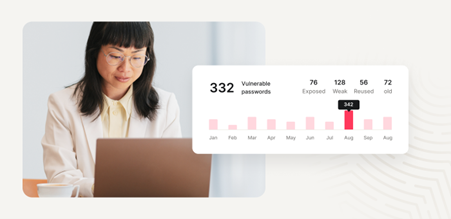
The platform must provide company-wide visibility into password strength and exposure. A Password Health tool should flag weak, reused, or old credentials, while a Data Breach Scanner checks whether any accounts tied to your company’s monitored domain have appeared in known breaches, helping IT respond early and reduce risk.
Email Masking
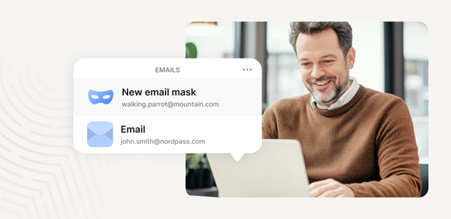
For non-critical third-party sign-ups, employees can use alias addresses instead of their primary corporate email. If a masked email is ever compromised in a third-party breach, your company’s real email accounts stay protected, localizing and mitigating the fallout.
Essential Practices for a Complete Defense
Credential management is a powerful layer, but a complete email security approach requires these foundational best practices:
- Multi-Factor Authentication (MFA): Mandatory for all email accounts.
- Phishing Filters: Robust threat detection tools at the gateway level.
- Employee Training: Consistent, engaging training to identify suspicious messages and social engineering tactics.
- Policy Enforcement: Strict policy around unique and complex passwords, coupled with immediate access revocation for departing employees.
Email is still a business essential, but also a high-value target. By enforcing strong password hygiene, reducing human error, and protecting credentials with a robust zero-trust solution, organizations can build a strong line of defense against the $2.8 billion threat of BEC. NordPass Business plays a valuable role in the email security strategy by helping organizations enforce strong password hygiene, reduce human error, and protect credentials tied to sensitive email accounts, offering a practical place to start.