Stablecoins, T+0 settlement, and the $40 trillion payments tipping point
The future of global finance won’t be built on a trade-off between traditional banking and decentralized technology, but on their seamless integration. That was the clear message from the “The Financial Infrastructure of Tomorrow: DeFi Meets Traditional Finance Powered By AWS” panel at Money20/20 USA, which brought together industry architects from across the payments and […]
-
Nikita Alexander
- October 30, 2025
- 4 minutes


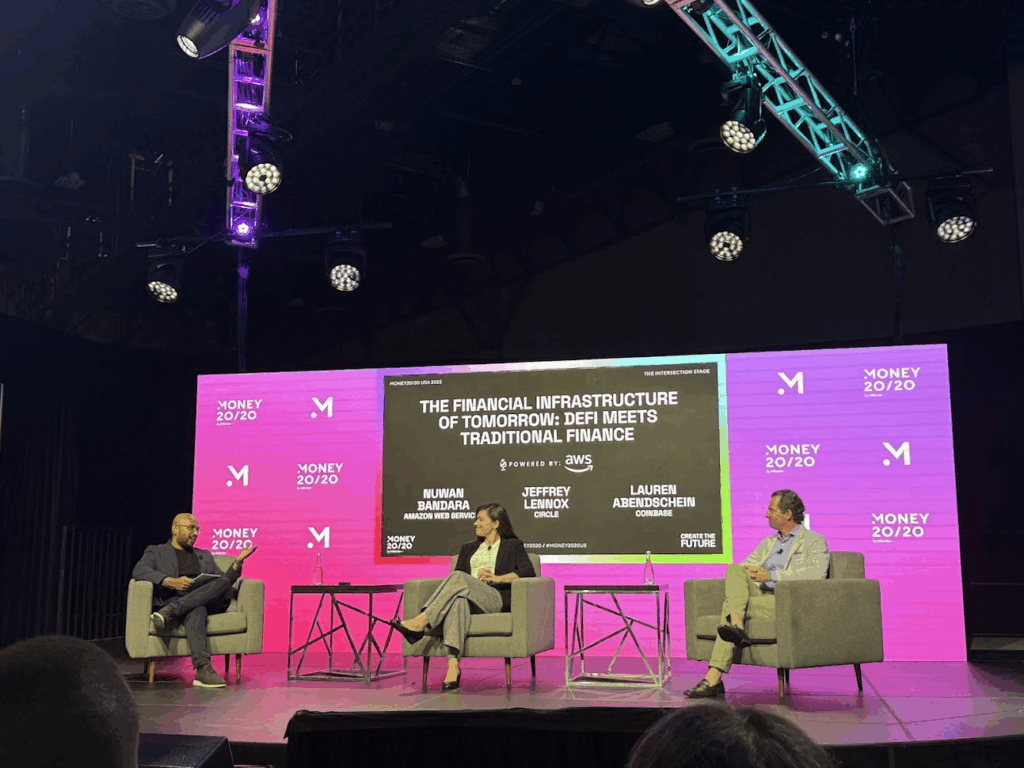
The future of global finance won’t be built on a trade-off between traditional banking and decentralized technology, but on their seamless integration. That was the clear message from the “The Financial Infrastructure of Tomorrow: DeFi Meets Traditional Finance Powered By AWS” panel at Money20/20 USA, which brought together industry architects from across the payments and capital markets spectrum.
Featuring insights from Nuwan Bandara (AWS), Jeffrey Lennox (Circle), and Lauren Abendschein (Coinbase), the session on the Intersection Stage confirmed what many industry observers have suspected: the transition to a cloud-native, stablecoin-powered financial system is past the tipping point.

Here are the key takeaways and actionable intelligence for our UK and US-based audience.
The Stablecoin Standard: $40 Trillion and Rising
The scale of stablecoin adoption is no longer a niche conversation—it is a direct challenge to the global payments establishment. The total processing volume for stablecoins is forecast to hit an astonishing $40 trillion in 2025, surpassing the combined volume of Visa and Mastercard.
This explosive growth is driven by utility:
- Eliminating Friction: Stablecoins, particularly USDC, are proving to be the new plumbing for finance. Circle, the creator of USDC (which currently has over $70 billion in circulation), is driving real-world adoption through strategic partnerships and platform engineering.
- Cost & Speed: The infrastructure is transforming inefficient correspondent banking by enabling 24/7 settlement and reducing costs by as much as 95%.
- Ubiquity: To cement USDC’s role as the global cash layer, Circle developed the Cross-Chain Transfer Protocol (CCTP), allowing the asset to move seamlessly across multiple chains like Ethereum, Avalanche, and Base, minimizing blockchain complexity for enterprise users.
As Circle’s Jeff Lennox noted, the focus is now shifting from crypto trading towards real-world use cases like cross-border payments, treasury management for large corporates, and increasing access to financial services in emerging markets.
Institutional Acceleration: The Citi-Coinbase Nexus
Institutional adoption is moving at pace, spurred by increasing regulatory clarity (such as the GENIUS Act and MiCA in the EU). Coinbase, an early adopter of AWS infrastructure, is leading the charge on the trading and custody side.
A major headline from the conference itself was the newly announced collaboration between Citi and Coinbase. The partnership aims to develop digital asset payment capabilities for Citi’s institutional clients, initially focusing on streamlining fiat pay-ins and pay-outs and payments orchestration to enhance the bridge between traditional and digital finance.
For high-frequency traders and asset managers, the primary driver is the move to T+0 settlement. This real-time capability is revolutionizing institutional markets by dramatically reducing counterparty risk and capital requirements, a massive operational and financial advantage.
Coinbase is catering to this demand through Coinbase Prime, which provides multi-venue trading, financing, and custody for the world’s largest hedge funds and market makers. Furthermore, the firm’s expanding derivatives business, bolstered by its acquisition of Deribit—is exploring the acceptance of USDC as collateral, further integrating the stablecoin into the foundational structure of capital markets.
From Micro-payments to $16 Trillion in Tokenized Assets
The infrastructure built for institutions is simultaneously unlocking new consumer and business models.
- Agentic Commerce: Coinbase’s revival of the dormant HTTP Expo 02 protocol enables micro-payments. This allows for a paradigm shift from costly monthly subscriptions (e.g., $30 for an article) to paying mere pennies for content. Critically, this foundational plumbing is essential for the coming era of agentic commerce, where AI-powered software agents will autonomously transact with each other without human intervention—a “ChatGPT moment for payments”.
- Real-World Asset (RWA) Tokenization: This domain is experiencing a significant boom, with forecasts predicting RWA tokenization will hit $16 trillion by 2030. This is not a future concept but a present reality, with some of the world’s largest asset managers already active:
- Blackrock’s BUIDL fund has surpassed $500 million in AUM.
- Securitize has tokenized over $3 billion in real-world assets for firms like KKR, democratizing access to previously inaccessible private equity funds. Tokenization reduces minimum investments from $5–10 million down to $50–100k, simultaneously cutting bond issuance costs by up to 90%.
The Cloud-Native Foundation
The consensus among the panellists was that none of this transformation would be possible without a secure, scalable, and global infrastructure partner. AWS provides the cloud-native rails for the entire ecosystem, enabling massive scale and security.
This includes:
- Security: Multi-layer security architecture, including AWS Nitro enclaves, provides hardware-backed security and cryptographic attestation for customers managing hundreds of billions of dollars in custody.
- Performance: Ultra-low latency environments on AWS, utilizing technologies like EC2 cluster placement groups, are vital for institutional trading and deep liquidity creation.
- Scale: The AWS infrastructure is leveraged by major players, including Zero Hash (processing 60 billion stablecoin transactions) and Coinbase (running its low-latency exchange).
The takeaway is clear: the foundation for a 24/7, T+0, programmatic financial system is fully built out and operational. For fintechs and traditional institutions alike, the time to build on these new financial rails is now.