PayPal Showcases Platform Growth Strategy at Money20/20 USA
At Money20/20 USA in Las Vegas, PayPal demonstrated how its expanding ecosystem is helping platforms scale faster and smarter. During the Grow Your Platform with PayPal session at Chica restaurant, company leaders shared how flexible, modular solutions are enabling partners to onboard merchants efficiently, strengthen compliance, and drive revenue growth in today’s competitive digital landscape. […]
-
bobsguide
- October 29, 2025
- 4 minutes


At Money20/20 USA in Las Vegas, PayPal demonstrated how its expanding ecosystem is helping platforms scale faster and smarter. During the Grow Your Platform with PayPal session at Chica restaurant, company leaders shared how flexible, modular solutions are enabling partners to onboard merchants efficiently, strengthen compliance, and drive revenue growth in today’s competitive digital landscape.
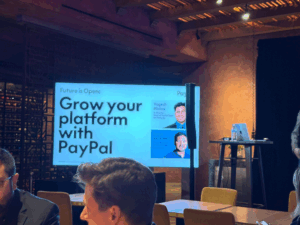
The session was led by Yogesh Mishra, Senior Director of Product Management for PayPal Complete Payments, and Satya Akkireddy, Head of Partner Platforms in Embedded Payments and Financial Services. Together, they outlined how PayPal’s evolving platform model is transforming the way businesses build and scale in the fintech economy.
From Payment Processor to Platform Enabler
For many in fintech, PayPal has long been synonymous with digital payments. This session revealed a broader ambition: helping platforms become fintech operators themselves.
“Platforms today compete on experience,” said Yogesh Mishra. “They need to move fast, onboard merchants seamlessly, and maintain compliance without adding complexity. That’s what our platform delivers.”

Yogesh Mishra
The PayPal Open for Platforms framework offers three integration models: Connected Path, Co-branded, and Embedded. Each allows partners to define how much of the merchant experience they want to manage. Whether through hosted checkout, white-labeled components, or full API integrations, PayPal adapts to meet platforms at any stage of maturity.
Scaling Smarter With PayPal

Satya Akkireddy detailed how PayPal helps partners scale without compromise. Through modular APIs, end-to-end onboarding, and real-time merchant visibility, platforms can expand into new markets while maintaining control and compliance.
He explained how embedded onboarding enables merchants to activate payments in minutes using existing KYC data and consent flows. This low-friction experience accelerates adoption for vertical SaaS and marketplace platforms where time to revenue is critical.
PayPal also enables global expansion from day one. With support across 200+ markets and 140 currencies, and regulatory licenses that remove the need for partners to secure their own, PayPal allows platforms to scale confidently and compliantly.
“Scaling used to mean adding risk,” Akkireddy said. “Now it means adding capability.”
One Integration, Global Reach
PayPal’s unified payments stack supports PayPal, Venmo, Pay Later, major cards, Apple Pay, Google Pay, and 100+ local methods through a single SDK or API.
“It’s a full-stack solution that lets merchants go live quickly, securely, and globally,” Mishra explained. The platform also supports in-store transactions with tap-to-pay, QR code payments, and POS integrations.
Merchants can access funds instantly through PayPal’s business debit card, which includes 1% cashback and built-in expense management tools.
Financing, Risk, and Revenue
The team also showcased PayPal’s suite of financial services designed to help merchants grow. Products such as PayPal Working Capital and Business Loans allow partners to embed financing directly within merchant dashboards, offering flexible funding options with fast approval and transparent repayment.
PayPal’s advanced risk management infrastructure combines buyer and seller protection with machine learning–driven fraud detection. With 97% buyer recognition and global transaction coverage, the platform ensures both security and trust.
“We’re not just processing payments,” said Mishra. “We’re building the infrastructure for growth.”
Tools for Partners
Akkireddy highlighted PayPal’s Partner Portal, an operational dashboard that gives platforms visibility into their merchants’ onboarding status, transactions, and funding activity.
From portfolio-level insights to account-level troubleshooting, the portal allows partners to monitor performance, identify compliance issues, and track revenue in one place. “It’s about giving platforms the data they need to act quickly,” Akkireddy said.
The Future: Modular and Merchant-First
Paypal closed with a look ahead to deeper embedded finance capabilities and new monetization opportunities for partners.
Through prebuilt SDKs and configurable APIs, platforms can white-label PayPal’s services while maintaining full control over their brand and user experience. “Your merchants don’t need to see PayPal,” Mishra said. “You own the relationship; we power the infrastructure.”
The takeaway was clear: platforms no longer have to choose between scale, compliance, and control. With PayPal’s platform model, they can achieve all three. As one attendee put it, “PayPal isn’t just a payments brand anymore. It’s a platform for platforms.”