Revolut’s $40 bln valuation goals outstrip Europe’s banking giants
Revolut is targeting a valuation exceeding $40 billion with its planned share sale, positioning it as Europe’s most valuable startup.
The $40 billion valuation surpasses traditional banks like NatWest and Societe Generale, reflecting a more than 20% increase from its previous $33 billion valuation in 2021.
-
Marina Mouka
- June 25, 2024
- 3 minutes

Revolut is on the cusp of a notable achievement as it eyes a valuation exceeding $40 billion through its anticipated share sale, positioning itself as Europe’s most valuable startup. This ambitious target would surpass the market capitalisations of well-established banks like NatWest and Societe Generale, bringing it in line with Lloyds Banking Group.
A significant leap from its $33 billion valuation in 2021, this projected increase of over 20% highlights Revolut’s resilience amidst a market where other fintech valuations, such as Klarna’s, have seen considerable declines. Despite facing regulatory hurdles, the company’s ability to secure substantial investments and maintain competitiveness against traditional banking institutions signals its potential for ongoing growth.
Founded in 2015 by Nik Storonsky and Vlad Yatsenko, Revolut has rapidly outpaced competitors such as Monzo and Starling in customer acquisition and global expansion. Boasting a global customer base of 40 million, with a third located in the UK, the fintech giant has demonstrated remarkable scalability.
Revolut’s diverse revenue streams, encompassing payments, subscriptions, and trading services, have been pivotal to its financial success. In 2022, the company reported revenues of $1.1 billion, marking a 45% increase from the previous year. This growth trajectory has been fuelled by strategic investments from prominent players including SoftBank’s Vision Fund 2 and Tiger Global Management.
In 2021, Revolut secured $800 million from key investors, providing the financial backing required for its aggressive expansion and innovative endeavours. The collaboration with Morgan Stanley to manage the sale of $500 million worth of existing shares further underscores its strategic approach to capital raising.
A league above traditional and fintech competitors
Revolut’s $40 billion valuation places it in a distinctive position within the financial sector, outstripping many traditional banks and fintech firms alike. This valuation exceeds that of UK lender NatWest and France’s Societe Generale, while also rivaling Lloyds Banking Group.
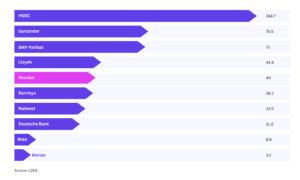
In comparison to other fintech entities, Revolut stands as a towering presence. Publicly listed Wise holds a market capitalisation of $8.9 billion, whereas direct competitors Monzo and Starling are valued at $4.6 billion and $3.2 billion, respectively. Unlike Monzo and Starling, which are confined to the UK market, Revolut’s international reach spans 40 million customers worldwide.
Revolut’s journey has not been devoid of challenges, particularly in the regulatory sphere. The fintech has been awaiting approval for its UK banking licence for over three years, a critical step for enhancing its lending operations. Delays have been partly due to auditors’ challenges in fully verifying revenue figures from its 2021 accounts.
Despite these obstacles, Revolut posted a revenue of $1.1 billion in 2022, a substantial 45% increase from the previous year. However, a decline in cryptocurrency trading and escalating operational costs have impacted its profitability, illustrating the complexities of balancing regulatory compliance with financial growth.
Looking forward, Revolut’s future appears promising. With a projected revenue of $2 billion for 2023 and an expected double-digit net profit margin, the company’s financial health seems robust.
Securing the UK banking licence remains a pivotal objective that could significantly bolster its lending capabilities. Achieving this would not only enhance Revolut’s market position but also affirm its potential for sustained growth and innovation in the competitive fintech landscape.