How Nvidia surpassed Microsoft and Apple to become world’s most valuable company
Nvidia, the California-based computer chip firm, has moved ahead of tech giants Microsoft and Apple to become the most valuable company in the world. But how did this happen?
-
Marina Mouka
- June 21, 2024
- 7 minutes

Nvidia Corporation has overtaken Microsoft and Apple in market value, emerging as the world’s most valuable public company.
Shares climbed as high as 3.4% on June 18, dethroning Microsoft and Apple, as investors increasingly place their bets on the chip-maker’s critical role in the AI market. Shares closed at $135.58 each – Nvidia’s market valuation soared to about $3.35 trillion.
Over the past few weeks, Nvidia has been battling with Microsoft and Apple for the top market valuation during a tech stock boom. Earlier this month, Nvidia moved past Apple to claim the second-highest spot, although Apple briefly regained it following the announcement of its AI strategy and a significant partnership to integrate OpenAI’s ChatGPT technology into Apple products.
The battle for market dominance: Microsoft vs Apple vs Nvidia
Nvidia’s shares have increased by more than 215% over the past 12 months and over 3,400% in the last five years. Year-to-date, Nvidia has seen a 175% rise, while Microsoft’s stock has gained just under 19% in 2024.
Nvidia first reached a $1 trillion market cap on June 13, 2023. The stock surpassed the $2 trillion mark on March 1, 2024 and quickly crossed the $3 trillion threshold on June 5, marking the fastest ascent from $1 trillion to $3 trillion in history.
“The ranking is yet another reminder that AI is the top focus of many investors. Nvidia is seen as the biggest and earliest beneficiary of the technology as it dominates the market with its highly sought-after chips that help power data centers running complex computing tasks required by AI applications,” Bloomberg reported.
“Demand for its H100 accelerators is surging and helped drive the chip maker’s sales up by more than 125% last year.”
This shift in ranking highlights the critical importance of AI for investors. Nvidia is widely viewed as the leading and primary beneficiary of the mainstream adoption of AI technology, holding a dominant market position with its highly sought-after chips.
While Microsoft is recognised as an early AI leader due to its investment in the partnership with OpenAI, the creator of ChatGPT, Apple only recently unveiled its AI initiatives, prompting a recent stock surge that satisfied investors.
Analysts foresee intense competition among Nvidia, Apple, and Microsoft for the first $4 trillion market cap in the tech industry, as noted by Wedbush Securities analyst Daniel Ives.
Investors and Nvidia CEO Jensen Huang perceive the company as more than just a chipmaker.
“They’re not just selling chips, they’re selling systems,” stated Michael Lippert, vice president and portfolio manager at Baron Capital Inc., to Bloomberg. He highlighted Nvidia’s proprietary software and ecosystem as significant differentiators.
Pixels, processors, and pioneering AI
Nvidia was founded in 1993 by Jensen Huang, Chris Malachowsky, and Curtis Priem. Initially, the company focused on developing GPUs for the burgeoning video game industry. These GPUs were designed to handle complex graphics calculations, making video games more visually impressive and realistic. Early successes, such as the RIVA series and later the GeForce line, established Nvidia as a leader in the gaming industry.
However, Nvidia’s ambitions extended far beyond gaming. Recognising the potential of their GPU technology, Nvidia invested heavily in research and development to explore new applications. This foresight led to the creation of CUDA (Compute Unified Device Architecture), a parallel computing platform and API model. CUDA enabled GPUs to handle general-purpose computing tasks, opening up new markets in scientific research, artificial intelligence (AI), and data analytics.
The real game-changer for Nvidia was indeed its pivot to AI. The explosion of AI and machine learning applications created an insatiable demand for computational power. Nvidia’s GPUs, with their parallel processing capabilities, were ideally suited to meet this demand. This alignment of technological capability with market need was unforeseen and highly profitable.
Nvidia’s GPUs became the hardware of choice for AI researchers and tech giants like Google, Amazon, and Microsoft. The company’s GPUs powered data centres and supercomputers globally, further entrenching Nvidia in the AI ecosystem. By 2020, Nvidia’s AI-driven business model was firmly established, with AI and data centre revenues surpassing those from gaming for the first time.
Riding the financial waves
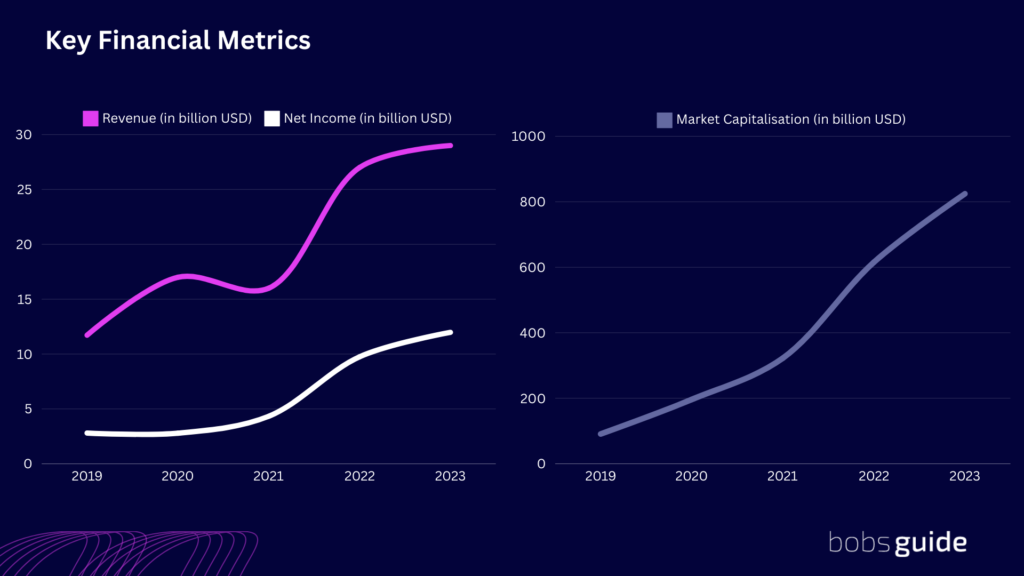
Nvidia’s financial performance has been nothing short of spectacular. The company’s revenue and profits have seen exponential growth, particularly over the past five years. For instance, Nvidia’s revenue in FY 2021 was $16.68 billion, a 52.7% increase from the previous year. By FY 2023, this figure had surged to over $26 billion.
The company’s stock performance mirrored this financial growth. Nvidia’s share price has increased by over 591,078% since its IPO in 1999, driven by its dominance in AI and data centre markets.
Source: Nvidia
These financial metrics illustrate Nvidia’s rapid growth trajectory and its ability to generate significant shareholder value.
Power moves and precision
Nvidia’s growth was also fuelled by a combination of strategic acquisitions and a robust culture of innovation. One of the most notable moves was the acquisition of Mellanox Technologies for $6.9 billion in 2019, a purchase that expanded Nvidia’s capabilities in high-performance computing and data centre networking. This acquisition was crucial as it allowed Nvidia to offer a more comprehensive suite of data centre solutions, integrating Mellanox’s high-speed networking technology with Nvidia’s GPUs.
Building on this momentum, Nvidia attempted another audacious acquisition: ARM Holdings for $40 billion. Although the deal faced significant regulatory hurdles and was eventually abandoned, it underscored Nvidia’s ambition to dominate the semiconductor industry by merging ARM’s CPU design prowess with its own GPU expertise.
At the helm of this strategic expansion is CEO Jensen Huang, whose visionary leadership has fostered a culture of innovation and excellence. Huang’s ability to anticipate market trends and steer the company accordingly has been instrumental in Nvidia’s success. This culture is supported by a strong emphasis on research and development (R&D), with Nvidia consistently investing around 20% of its revenue into R&D efforts.
Nvidia’s operational efficiency has also been a critical factor. Despite rapid growth, the company has managed to maintain high-profit margins and return on equity (ROE), showcasing effective management and strategic execution.
From crisis to crypto
Nvidia’s ascent was also influenced by broader market dynamics and external factors. The COVID-19 pandemic accelerated digital transformation and remote work, boosting demand for data centres and cloud computing. Nvidia’s GPUs, being integral to these technologies, saw a corresponding increase in demand.
Additionally, the growing interest in cryptocurrencies and blockchain technology also played a role. Nvidia’s GPUs are widely used for cryptocurrency mining, which added another layer of demand. While the company faced some regulatory scrutiny over this, it nonetheless benefited from the cryptocurrency boom.
However, Nvidia’s journey has not been without its challenges. The semiconductor industry is highly competitive, with companies like AMD and Intel continually innovating. AMD, in particular, has been a formidable competitor in the GPU market, challenging Nvidia’s dominance with its Radeon line.
Geopolitical tensions further complicate the landscape. The ongoing trade war between the US and China also had implications for Nvidia’s supply chain and market access. Regulatory hurdles in various jurisdictions have also impacted Nvidia’s strategic initiatives, as seen with the failed ARM acquisition.
The road ahead
Looking ahead, Nvidia’s prospects remain bright, but the company must navigate a complex landscape. The AI revolution is still in its early stages, and Nvidia’s GPUs are likely to remain central to AI and machine learning applications. The company is also exploring new frontiers such as autonomous vehicles, augmented reality (AR), and the metaverse, which present significant growth opportunities.
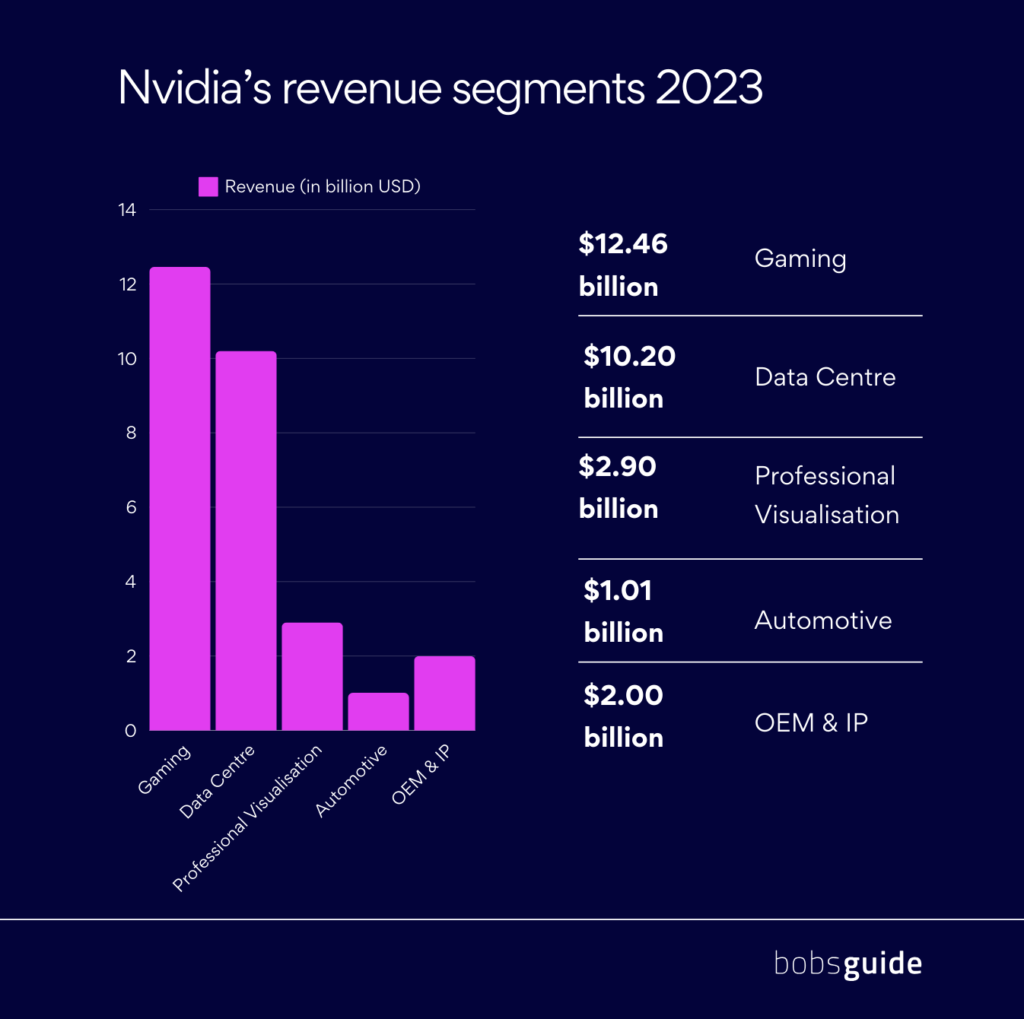
Another critical aspect of Nvidia’s strategy is diversification. The company’s revenue is increasingly coming from a variety of segments, not just gaming. Here’s a breakdown of Nvidia’s revenue segments for 2023:
Source: Nvidia
This diversification reduces Nvidia’s reliance on any single market, providing stability and opening new growth avenues.