Volante’s Deepak Gupta on the Big Beautiful Bill and GENIUS Act
In an exclusive Q&A, we sit down with Volante’s Deepak Gupta to unpack the far-reaching implications of the Big Beautiful Bill and the GENIUS Act.
-
Nikita Alexander
- September 19, 2025
- 4 minutes
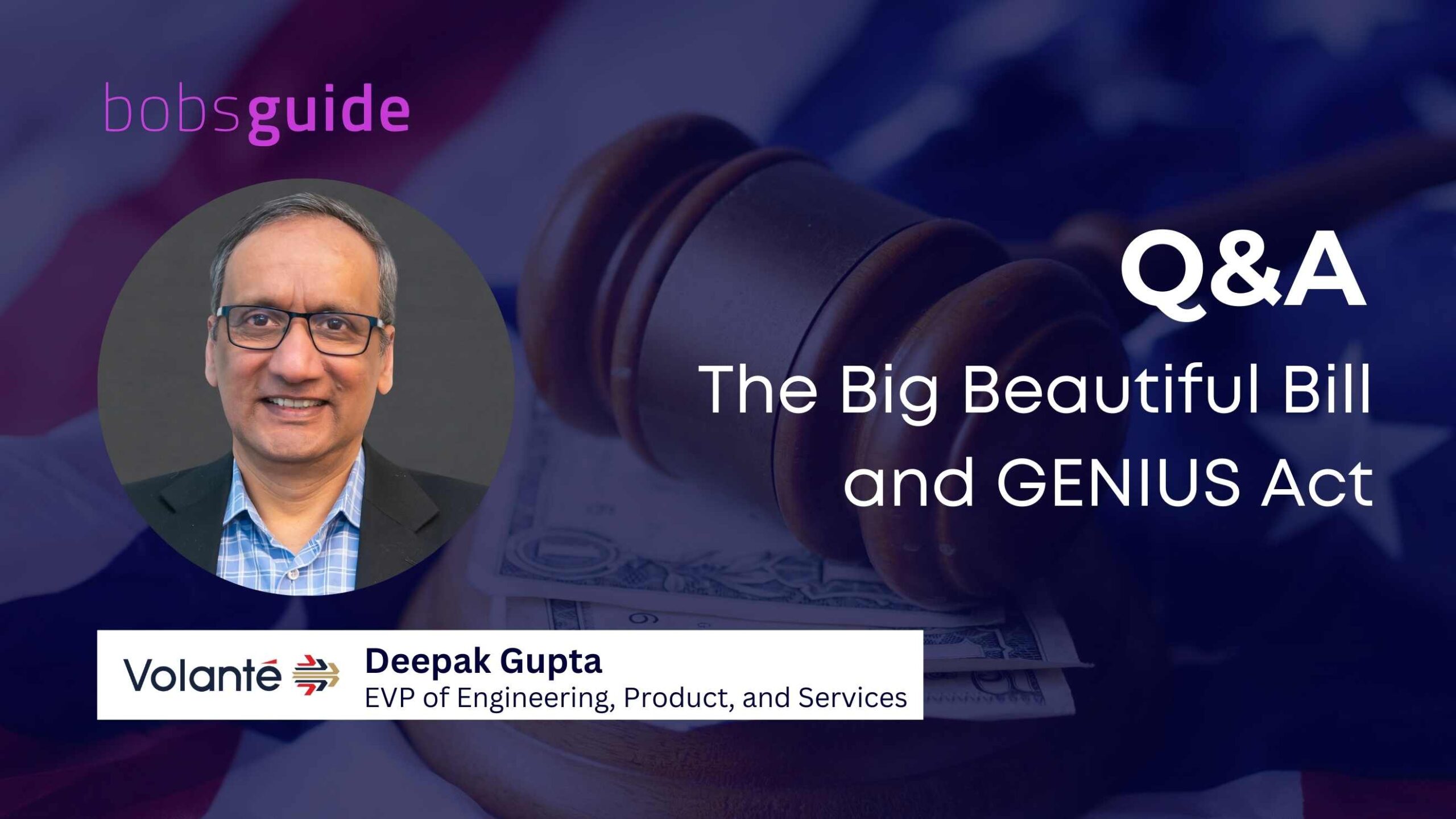
For financial institutions in the UK and US, a new era has dawned with the passage of two landmark pieces of legislation: the Big Beautiful Bill and the GENIUS Act. To understand the profound implications of these acts on the payments landscape, Bobsguide sat down with Deepak Gupta, EVP of Engineering, Product, and Services at Volante Technologies. A career innovator in cloud and software-as-a-service, Gupta’s insights illuminate the transformative pressures and opportunities facing the industry.
The GENIUS Act
Gupta begins by stating that the passage of the GENIUS Act and the Big Beautiful Bill marks a “watershed moment” for payments. He explains that the GENIUS Act provides the long-sought regulatory clarity for stablecoins, effectively shifting the industry’s conversation from “if we can use them” to “how we can integrate them.” By mandating 1:1 reserve backing with high-quality, liquid assets, the act transforms stablecoins from speculative instruments into trusted financial tools.
“This clarity gives banks confidence to integrate stablecoin-based payment infrastructure,” Gupta notes, “and explore models ranging from issuing their own coins to partnering with external providers.” He highlights that the most compelling immediate use cases are in cross-border payments and treasury liquidity, where stablecoins can dramatically reduce friction and shorten settlement times from days to seconds. Domestically, while real-time payments are already supported by systems like FedNow and RTP, stablecoins, combined with always-on rails and ISO 20022 data, could unlock entirely new efficiencies internationally for corporates.
The Big Beautiful Bill
Complementing the GENIUS Act, the Big Beautiful Bill incentivizes technology investment and modernization, pushing financial institutions to accelerate cloud migration, multi-rail readiness, and AI adoption. According to Gupta, this bill creates both an opportunity and a pressure point for banks. The legislation’s reinstatement of 100% bonus depreciation for certain research and development expenditures provides a strong financial motive to upgrade.
Gupta points out that banks still dependent on legacy systems will face a significant challenge. These siloed, costly, and difficult-to-scale systems are now an existential liability. He emphasizes that the new framework demands a prioritization of flexible, cloud-native, API-first platforms that allow new rails like stablecoins to be added without costly, bespoke builds. For Gupta, orchestration layers are crucial, as they enable banks to plug in new payment types while maintaining compliance and resilience. He also sees AI as a critical tool for managing the operational risks of modernization, helping to monitor flows and detect anomalies.
Why Delaying is No Longer an Option
Gupta believes that the two acts together create a “perfect storm” for modernization. The GENIUS Act provides the regulatory clarity for digital assets, while the Big Beautiful Bill mandates the technology upgrades. This dual pressure means that delaying modernization is no longer a viable strategy for traditional FIs.
“For early movers, the window of opportunity is the next 18–24 months,” Gupta asserts. He suggests that banks who pilot stablecoin solutions and demonstrate multi-rail integration will gain a competitive edge with corporate treasurers seeking faster, programmable payments. He outlines the essential components of a modern infrastructure: cloud-native, API-first, multi-rail orchestration, ISO 20022 data capabilities, and embedded AI. A phased rollout, he recommends, can balance the need for speed with risk management.
The Future of Payments
Gupta predicts that by 2026, successful banks will have stablecoin pilots live, multi-rail orchestration in production, and AI-driven compliance tools embedded. The most urgent upgrades, he states, are smooth on/off-ramping between fiat and digital assets, wallet integration, and scalable cloud infrastructure.
Looking ahead to 2030, Gupta believes the payments landscape will be fundamentally different: faster, data-rich, and programmable by default. He expects that stablecoins and other regulatory-backed digital assets will operate alongside traditional networks, with interoperability being the key to success. Gupta offers three immediate, critical actions for banks:
- Build on/off-ramp capabilities for stablecoins to ensure seamless integration.
- Deploy orchestration platforms that support multiple payment rails simultaneously.
- Invest in AI for compliance, fraud detection, and operational efficiency.
By prioritizing investments that deliver both regulatory compliance and customer value, Gupta concludes, institutions can position themselves to win in a more competitive, digital-first payments ecosystem.