Global geopolitical tensions – The overlooked threat to a borderless fintech world
The promise of fintech has always been a borderless, interconnected financial ecosystem. Yet, a new and formidable challenge is emerging: the fragmentation of the global economy driven by geopolitical tensions, trade tariffs, and regulatory divergence. This article explores the nuanced and often overlooked impact of these geopolitical shifts on the fintech industry. We dive into how rising protectionism is affecting cross-border payments, demanding new approaches to regulatory compliance, and creating both significant risks and unexpected opportunities for financial technology firms.
-
Nikita Alexander
- August 7, 2025
- 5 minutes

The ethos of the fintech revolution has long been one of seamless global connectivity. By leveraging digital technology, fintech promised to dismantle the traditional barriers of time, cost, and geography that have historically governed financial services.
Yet, this vision of a truly borderless, interconnected financial world is being challenged by a powerful counter-force: the rise of global geopolitical tensions. As trade conflicts, sanctions, and protectionist policies become more prevalent, the fintech industry finds itself navigating an increasingly fragmented and complex operational landscape.
This article explores the profound and often overlooked impact of these geopolitical shifts on fintech. From disrupting cross-border payments to creating immense regulatory challenges, the new era of global tensions is reshaping the strategic imperatives for financial technology firms and demanding a proactive, nuanced approach to risk management, compliance, and international strategy.
The Financial Services Impact
The financial sector has always been at the frontline of geopolitical conflict, with sanctions and trade disputes frequently weaponized as tools of foreign policy. For fintech, this plays out in several critical areas:
-
Disruption to Cross-Border Payments:
- The Challenge: Fintechs that facilitate cross-border payments, from large remittance providers to smaller payment gateways, are highly vulnerable to new tariffs and sanctions. Sudden changes in policy can lead to network disruptions, compliance failures, and increased costs. An institution might be forced to cease operations in a specific region overnight, impacting both customers and revenue.
- The Opportunity: This fragmentation creates a demand for more resilient, agile, and diversified payment networks. Fintechs offering solutions that can dynamically route payments, comply with local regulations, and provide alternatives to traditional SWIFT or correspondent banking networks may find new market opportunities.
-
Increased Regulatory Complexity (The Rise of Geopolitical RegTech):
- The Challenge: As jurisdictions diverge on trade and sanctions policies, fintechs must navigate a growing patchwork of regulations. An AI-driven compliance system that works perfectly in the UK may fail in the US if trade policies with a third country differ. This demands greater investment in sophisticated RegTech that can be rapidly reconfigured to address new mandates.
- The Opportunity: This creates a fertile ground for a new generation of “geopolitical RegTech” solutions. These platforms will need to use AI and machine learning to not only track sanctions lists in real-time but also to interpret complex, often ambiguous, regulatory texts and assess their impact on a firm’s global operations.
-
Investment and Funding Shifts:
- The Challenge: Geopolitical risk directly impacts investor confidence. Venture capital and private equity firms may become more cautious about funding fintechs with significant exposure to politically unstable regions or those caught in the crossfire of trade wars. This could lead to a slowdown in investment and a flight to perceived safer, domestic markets.
- The Opportunity: Conversely, domestic-focused fintechs may see a surge in investment as global players seek to de-risk their portfolios. Moreover, firms that can help businesses navigate this global complexity through technology may become particularly attractive to investors.
-
Data Sovereignty and Digital Protectionism:
- The Challenge: As nations impose new digital trade barriers and demand that data be stored and processed within their borders, fintechs that operate on cloud-based, globally integrated platforms face significant challenges. This “digital protectionism” requires complex, costly adjustments to infrastructure, data storage, and operational models.
- The Opportunity: This creates a demand for new technologies that can facilitate secure, privacy-preserving data collaboration that respects national sovereignty. Solutions like Confidential Computing and Homomorphic Encryption, which we’ve previously discussed, are perfectly suited to solve this challenge, enabling data to be processed securely in a distributed manner without it ever leaving a specific jurisdiction.
Navigating the Geopolitical Currents
For financial institutions and fintechs, adapting to this new geopolitical reality requires a strategic and proactive approach:
- Build a Resilient, Diversified Network: Companies must move away from over-reliance on a single jurisdiction or technology provider. Diversifying payment partners, cloud providers, and operational locations can mitigate the impact of sudden geopolitical shifts.
- Invest in Next-Generation Compliance: The era of rules-based compliance is over. Institutions must invest in AI-powered RegTech that is not only automated but also intelligent and adaptable, capable of interpreting regulatory intent and dynamically adjusting to new geopolitical realities.
- Adopt a “Think Global, Act Local” Mindset: A global strategy must be built on a foundation of local expertise. This means understanding not only the local financial regulations but also the political and cultural nuances that can affect business operations.
- Embrace New Technologies for Trust: In a world of increasing mistrust, technologies that provide cryptographic assurance of data privacy and transaction integrity are invaluable. Blockchain and advanced encryption can build trust where traditional diplomacy may fail.
- Focus on Proactive Risk Management: Geopolitical risk should be integrated into every aspect of a fintech’s risk management framework. This includes scenario planning, stress testing, and continuous monitoring of geopolitical indicators to anticipate potential disruptions.
The End of an Era, the Dawn of a New One
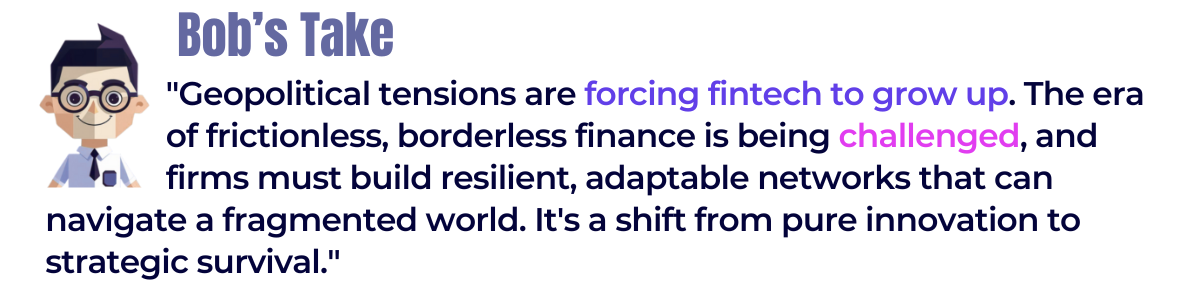
The era of a frictionless, globally integrated financial services industry is, for now, giving way to a more complex, fragmented, and geopolitically charged reality. For the fintech sector, this is not just a headwind but a defining challenge that demands a strategic response.
While the risks are significant, so are the opportunities. The fintechs that will thrive in this new environment will be those that are not only technologically innovative but also operationally resilient, regulatory-savvy, and strategically agile. By leveraging their core strengths to build solutions that bridge fragmented networks, automate complex compliance, and provide trust in an era of uncertainty, fintech can not only survive but lead the way into the next chapter of global finance. The new frontier is not just digital; it is geopolitical.