Checkout.com’s Matthieu Barral on payments, payouts, and partnerships
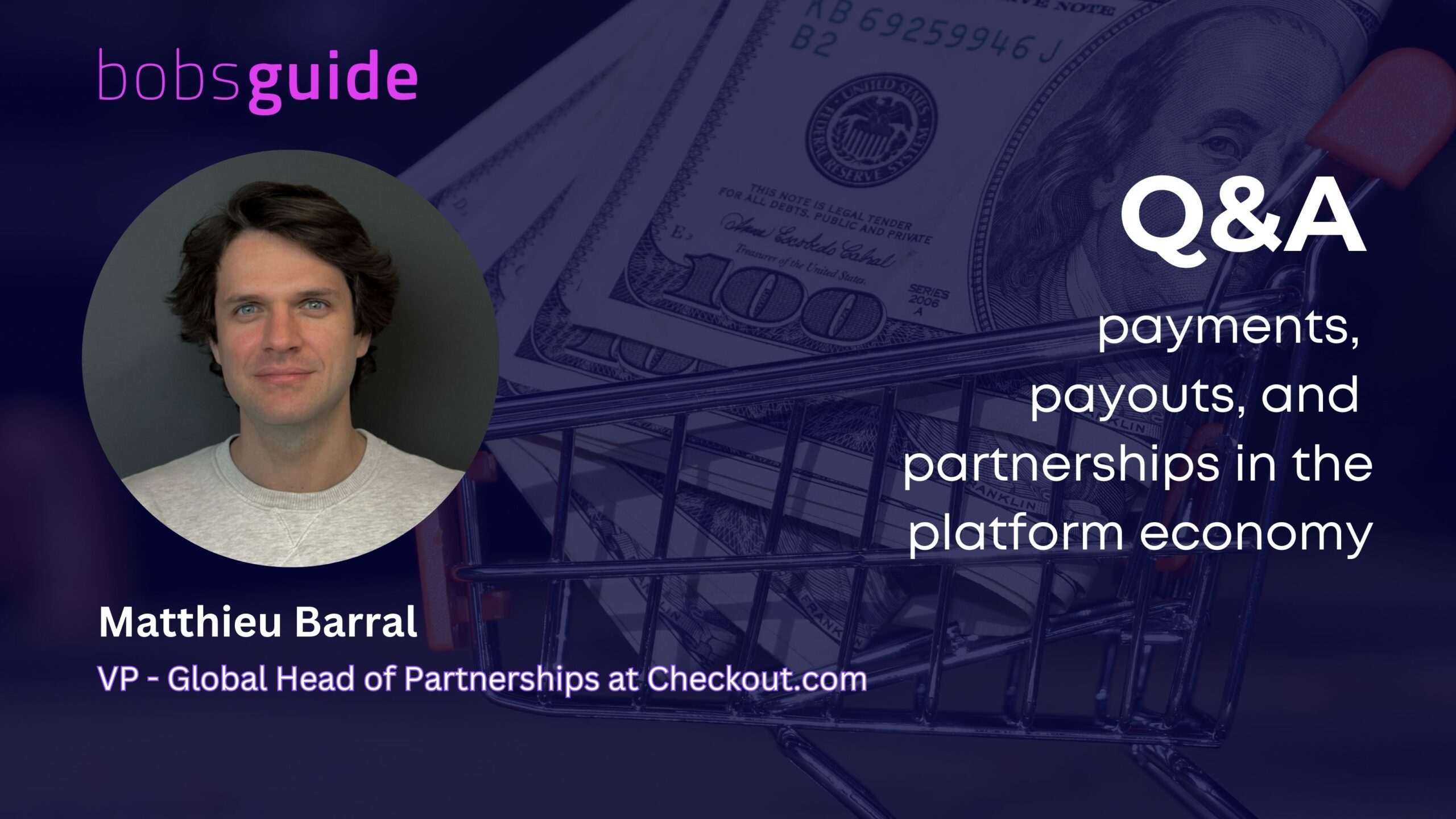
Matthieu Barral, Checkout.com’s VP of Global Partnerships takes us through how merchants can navigate a fragmented landscape of complex regulations, diverse payout needs, and dynamic fraud by leveraging strategic partnerships and embedded finance.
-
Editorial Team
- July 11, 2025
- 6 minutes
In today’s digital economy, the payment transaction is no longer the final step in the customer journey but the starting point for a complex web of financial operations.
For merchants, navigating this landscape means moving far beyond basic payment processing to meet consumer demands for localized payment options, real-time payouts, and seamlessly embedded financial services.
This evolution presents significant challenges, from managing a fragmented infrastructure to navigating a labyrinth of global regulations and dynamic fraud patterns.
To shed light on how strategic partnerships can solve these complexities, Bobsguide spoke with Matthieu Barral, VP of Global Partnerships at Checkout.com.
In this interview, we explore the transformation of partnership strategies, the key merchant segments driving demand for embedded finance, and the future of collaboration between payment providers and financing specialists.
How has Checkout.com’s partnership strategy evolved to address merchant needs beyond basic payment processing?
Checkout.com’s partnership strategy has transformed in recent years, in order to keep pace with the growth and evolution of the digital economy.
Today’s consumers expect an experience which is personal and relevant to them, when making a purchase online.
That means local payment options – everything from Bizum in Spain, UPI in India through to SEPA in Europe – along with the likes of universal ApplePay and GooglePay – must be supported.
This has seen us forge alliances with leading local payment schemes, digital wallets and Buy Now, Pay Later providers, in order to ensure that merchants can tap into every single channel that their customer needs.
And because merchants no longer just process payments, they need versatile, real-time payout capabilities. By partnering with innovators in virtual card issuing, direct card payouts and account-to-account transfers, we’ve built a single-API solution that benefits merchants.
It’s important to note that every decision we make starts with our merchants. They shape our products, inspire the solutions we build, and drive our partnerships.
Which merchant segments are showing the strongest demand for embedded finance solutions, and what specific financing needs are they looking to address?
Over the past year, we’ve seen the strongest appetite for embedded finance among financial services platforms, online travel marketplaces and the broader platform economy.
Headout, a marketplace for experiential travel, recently partnered with Checkout.com to roll out card issuing across Europe.
With branded virtual and physical cards, the team is enhancing customer rewards, simplifying expense management, and streamlining B2B payouts, gaining greater control over complex financial flows.
Similarly, Holiday Extras integrated our issuing platform, automating their booking and payment systems. This saved over 12 hours of manual processing each week and streamlined their error-checking processes.
More recently, Stake, a leading digital and real estate investment platform, just launched our Pay-to-Card feature, enabling investors to instantly receive dividends and returns directly to their bank cards, providing faster, frictionless investing experiences.
Real-time payouts are also crucial across platforms, including creator communities, gig workers, and marketplace sellers, with competition among businesses to provide immediate cash flow to their communities reaching an all-time high.
By embedding finance directly into their customer journeys, these sectors are not just accepting payments—they’re unlocking new revenue streams, reducing operational friction and delivering the fast, personalized experiences that today’s consumers demand.
What are the most common challenges merchants face from a financial partnership’s perspective?
From a financial partnerships standpoint, merchants face three major challenges that can make or break their ability to thrive in the digital economy.
Firstly, regulation and compliance brings complexity. Each market brings its own maze of rules—data localization, licensing, reporting and consumer-protection mandates vary wildly from one country to the next.
Implementing region-specific protocols like 3D Secure requires deep local expertise, and without a trusted partner, compliance efforts quickly become expensive, at risk of error and time consuming.
What’s more, payment and payout infrastructure is fragmented. Consumers expect to pay—and get paid—using the methods they know and trust, so integrating dozens of local schemes, wallets and finance options is a challenge.
On the payout side, merchants struggle to unify virtual-card issuing, direct-to-bank transfers and real-time disbursements under a single API, often juggling multiple vendors and reconciliation processes.
Last but not least, fraud patterns and techniques differ by region and channel, so a one-size-fits-all solution simply won’t cut it. Merchants need adaptive and dynamic controls—machine-learning models fine tuned for specific markets with real-time scoring.
Strategic partnerships abstract that complexity. By leveraging a single integration to cover compliance, local payment methods, payout options and advanced fraud controls, merchants can focus on growth.
How do you see the partnership ecosystem between payment providers and financing specialists evolving over the next few years?
The financial services ecosystem is becoming more specialized and fragmented, as time goes on. We’re seeing niche players crop up across credit, fraud, compliance and beyond.
As this ecosystem evolves, we have to make deliberate choices, and for some capabilities, the right move is to partner.
For others, we invest in building a full-stack platform, so our clients get a single, integrated solution. We’re all about performance, so whatever the approach, performance will be at the heart of it.
The conversation with Matthieu Barral underscores a fundamental shift in the financial services landscape: the era of one-size-fits-all payment solutions is over.
For merchants operating in the global platform economy, success now hinges on the ability to offer a sophisticated, localized, and unified financial experience.
As Barral highlights, the primary hurdles of regulatory complexity, infrastructure fragmentation, and adaptive fraud require more than just a transactional vendor relationship; they demand a strategic partner capable of abstracting that complexity through a single, integrated solution.
The strong appetite for embedded finance in sectors like online travel and digital investment platforms—evidenced by real-world examples from Headout, Holiday Extras, and Stake—proves that embedding finance is a powerful driver of operational efficiency and new revenue.
By leveraging partnerships to deliver versatile payout capabilities and diverse payment methods via a single API, merchants can focus on their core mission: delivering value and fostering growth in an increasingly competitive market.
Ultimately, the future points towards a more specialized but interconnected ecosystem, where the right blend of in-house builds and strategic partnerships will define market leaders.